Some people pursue enlightenment by sitting quietly and probing their inner consciousness; I make plane reservations. ~ Madeleine Albright

Tuesday, June 11, 2013

WWI in The Somme

Where can I begin about today's historical sights? This is such a beautiful part of the country, and all I can say is what a tragic, wasteful, horrifying loss of human life. I've taught WWI in my history class for 19 years, and I can tell you that I've never really understood the human cost until today. We drove by more than 100 WWI cemeteries and memorials, all within 20 minutes of Albert, and we stopped at fewer than 10 of them. Literally every little town we drove through had a statue, memorial, military cemetery, or some other commemoration for WWI. In addition to that, we were driving out through farmland all day, and there were too many cemeteries to count that were located out in the middle of someone's fields. We could have stopped at one every few minutes. It is simply unconscionable that, at the Battle of the Somme alone, the cost to the Allies was almost 624,000 casualties - nearly 420,000 of them British.

Every single town in the Somme region was completely leveled by this battle. People came back after the war and literally had to rebuild everything - homes, farmland, fences, businesses, streets, churches, etc. Towns and houses were rebuilt quickly with brick buildings instead of the typical creamy stones of older French cities. Public health leaders encouraged the building of wider streets, and cemeteries were moved to the outskirts of town. (The pic to the right is the town of Albert.)

Meanwhile, farmers came back to something even more unusual; they found makeshift cemeteries in the middle of their fields. Those pieces of land the cemeteries were on became the property of France (or Britain) and the farmers then gave up more land for access roads to these cemeteries. I don't know if they minded or not, what with all the rebuilding required everywhere else, but again it just reminds me that war always affects so many more people than just the soldiers that most people think of first. But it really is amazing to be driving through this beautiful farmland, with fields as far as the eye can see, and then to randomly come across a dirt road leading out to 100 white stone markers in the middle of a wheat field. (The pic at the left shows a good example - two cemeteries in the middle of fields, out in the middle of nowhere. Obviously, I got this one off the internet.)

No one in this region of France will ever be able to forget what happened here because there are physical reminders everywhere. And because this area was mostly where British troops were fighting the Germans, there are British tourists everywhere. We must have seen 20 different British school groups on field trips today, and we heard more English being spoken than French. The British take this war extremely seriously because it impacted them so much. 60,000 lost on the first day of the Battle of the Somme. One million deaths in the entire war, and that's from Britain alone! From that little tiny country! It's 1.3 million deaths if you count the other soldiers who belonged to the greater British Empire. It's unimaginable.

As you can tell, we could've spent weeks in this place if we wanted to see every single sight, but we chose the most memorable ones to focus on. We began our morning at the Museum of the Somme 1916, right here in Albert. It was a great museum, especially for students. It's located in the underground bomb shelters (hallways) of the Basilica of the Virgin, right in the center of the town. It has a lot of informative exhibits, including mannequin displays of different scenes from the trenches of WWI. The mannequins are a little old school, but I didn't mind. It was really interesting to see all the different uniforms, artifacts, etc. in each scene. There was also a long dark tunnel we walked through at the end where all you heard was a recording of the explosions and gunfire that would've been going on non-stop in trenches. I can see why so many school groups visit this museum.


This picture shows artifacts found after the war was over, and the next one shows something named "trench art." All the items in the picture are pieces of art created by the soldiers from shell casings and other pieces of metal found in and around the trenches. There are etchings on shells, hand made airplanes, etc. They are really beautiful. Some of these men were very skilled!


After the museum, we headed out of town to the Lochnager Crater located in the middle of someone's farm. It was created on July 1, 1916 when the British tunneled under the German front lines and detonated enough explosives to create multiple craters. The only one remaining is the Lochnager; it's 100 meters in diameter and 30 meters deep. It's so huge that I couldn't get a picture of the whole thing, so I had to find two online for you to see.


Next up was Thiepval. The memorial at Thiepval is one of the most moving memorials I've seen on this trip. It is a gigantic structure that is built on a slight rise so it's visible for miles around. It commemorates the 73,367 British and South African men who fell during the Battle of the Somme and who are unidentified. They have no known graves, and their names are engraved on the square pillars that form the base of the structure. It was just so emotional to read name after name as we walked through the memorial.


The picture to the right is a commonly seen token of remembrance at all the Somme memorials. This one made me cry more than any of the others. The top three sides of the cross say granddaughter, great granddaughter, and great great grandson; then the bottom has the name of their lost family member, J. Harrison. This token was placed right below his name on the wall (see the picture below). That's so amazing to see that his descendants still come here to remember him!


Then, beyond the memorial and down a slight hill sits a French-British cemetery; it was paid for equally by both countries and 300 dead from each country lie here. On the left are the simple crosses for the French soldiers, and on the right are the white stones for the fallen British soldiers. A beautiful and emotional place!


This is an exhibit inside the Thiepville visitor's center which shows the faces of several hundred of the thousands of missing soldiers commemorated at this site.


Just a few minutes down the road is the Ulster Tower which commemorates the Irish soldiers who fell during the Battle of the Somme. It's an exact replica of tower located near the Irish division's training camp in Belfast.


Our next stop was the Newfoundland Memorial Park at Beaumont-Hamel (B & H are two small adjoining towns). The main feature of the 16 acre park is a tall, grassy mound topped by a towering caribou who looks out over the trenches and bomb craters of the battlefield. It's an impressive and powerful memorial, and seeing the trenches up close was amazing! We've seen some of the Civil War trenches on the East Coast, but never ones from WWI. This was a really great experience!


Along the way to Longueval, we noticed another large cemetery on the side of the road, so we stopped to take a look. It was the Caterpillar Valley Cemetery, so named by the soldiers because of the twists and turns of the valley it's in. Like all the other British cemeteries, it made us very emotional. One of the stones was engraved in Moari to commemorate a fallen soldier of New Zealand.


The memorial at Longueval is really quite fantastic. It's for the fallen South African soldiers of the British Commonwealth, and it is huge. The memorial sits on one side of the road (in a huge green park), and across the road is the South African Cemetery. Both are striking and emotional. Behind the main statue of the memorial is a beautiful star shaped building which mimics the coastal forts in South Africa. In it is a beautiful series of exhibits about their soldiers and the Battle of the Somme as a whole.


The next to last stop was the German cemetery of Fricourt. This cemetery looks very different than the WWII German cemetery in Normandy. This one has very simple, thin iron crosses that mark the graves. Most of the crosses mark the site of four graves (one name on each arm of the cross, and the same on the other side of it). These dark crosses make the cemetery seem very dark and depressing. And interestingly enough, there were about 10-15 rounded stone markers for the German Jewish soldiers of the Somme. My first question was whether or not these markers were taken down when Hitler came to power in Germany, and/or if new markers were put up after WWII ended. I need to look that up online.


Our final sight of the day was the Welsh Division Memorial at Mametz. This is probably the most modern and mythic memorial we've seen. We drove for about 15 minutes down a long, winding one-lane road that sloped down towards Mametz Wood. We almost missed the memorial because its path up to it is so far out in the middle of nowhere and kind of hidden between grassy hills. But once we found the path and started walking up to the top, that bright red dragon appeared above us and made us laugh with joy that we were able to see something so fantastic. It's really quite a sight after all the other more traditional memorials! We loved it and were so glad we took the time to find it!


Monday, June 10, 2013

Ruins are Beautiful (part 2 of 2 for today)

(I saved my pictures into smaller files and was finally able to get them to upload. So I think I'm good to go even with this unreliable Wi-Fi in Albert!). :-)

After leaving Mont St. Michel, we headed on a five hour drive to Albert, France. We wanted to break up the drive, so we stopped at more abbey ruins along the way. This time it was Jumieges Abbey. I'm sure the pictures will probably look very similar to the ones from yesterday's ruins, but Jumeiges was so much bigger and better! It was absolutely fantastic! When it was a working abbey its church was called Notre Dame (like so many others), and it had multiple monastic buildings spread around the property. Most of those buildings are gone, and now the abbey ruins sit in the middle of a sprawling green park that sits right alongside the main road in the town of Jumieges. The road probably used to be part of the main pilgrimage road from Rouen to Mont St. Michel because there were many abbeys along the way. The abbey church is so big, we could see it rising above the town from several miles across the river Seine.

The building where we bought our tickets used to be the gatehouse to the abbey, and it is completely beautiful in its own right. From the gatehouse, we stepped out into the park and towering above us were the ruins of the church. Truly awesome! Listen, I can totally appreciate and respect what other people do for fun - camping, skydiving, shopping, etc - but my "drug of choice" is traveling to see historical sites any day of the week. Give me something hundreds of years old with a complicated and textured past and I am in heaven! This fit the bill perfectly!


There isn't really a lot to say about the pics because you can't really tell what any of the ruins were (except the church, of course). So I'll just let you enjoy the view...


When we finally had our fill of exploring every nook and cranny of the ruins, we hopped in the car and headed off for the other 2.5 hours of our journey to Albert. Albert is in the region of The Somme, so you'll be hearing all about WWI for the next few days. I can't wait!


Conquering the Mountain! (Part 1 of 2 for today)

Well, we did it! We hiked up a gazillion steps and saw a soaring cathedral as well as the rest of the weighty monastery. It was absolutely worth every stair we climbed! I can't really even explain the experience. This place wasn't like anything we've ever seen before. But I will do my best!

First of all, we got up early this morning so we could tour the ramparts and see the views without a bunch of other tourists! It was quiet and foggy and perfectly peaceful. There were maybe five of us total up there for about 30 minutes. Then slowly but surely a few more people started arriving. At that point we headed for the stairs that lead up to the main door. The place was supposed to open at 9:00 AM and we arrived at the stairs around 8:30 only to find a sign that said it would maybe open around 9:30. It seems all the employees are on some sort of strike because of the drastic changes they're making on the mainland side (building a new bridge), and it's impacting their daily arrivals/departures in a negative way. So we grabbed a step, along with all the other early arrivand had a seat to wait. Sure enough, at about 9:30 AM several ladies arrived to unlock the door, and to our great delight, they just waved us right past the ticket counter and didn't make us pay. I guess if they're on strike then they won't be very worried about getting fired over it! :-) So we saved 20 Euros!

So this is where it gets tricky to describe how many levels, rooms, halls, stairwells, etc. there are in this place. It is gigantic! We first walked up about 80 stairs to get to the wide open courtyard (terrace) that looks out over the Bay of St. Michel. You can see the lowland pastures across the bay on the mainland. It's absolutely beautiful, especially with the fog floating about making everything look a bit mysterious and enchanted.


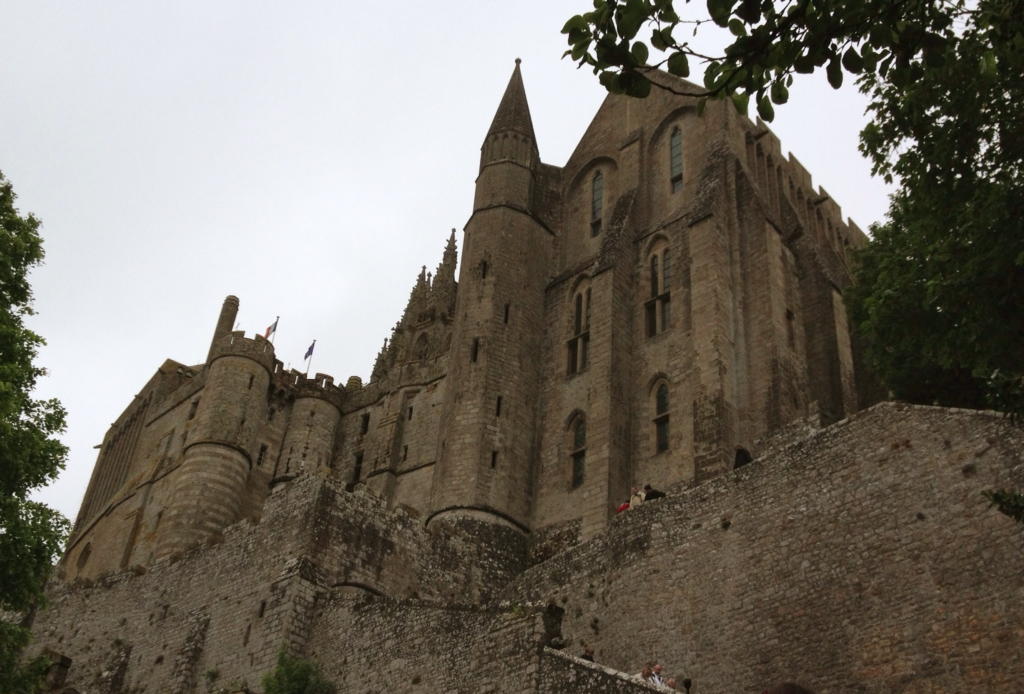
The abbey itself is made of grey stone instead of the creamy limestone we've seen everywhere else. All the buildings of the monastery are made of granite stones quarried from a nearby island. This gray color of the granite makes everything seem a little darker and heavier. But the abbey is still beautiful, and it's actually quite open and light for being made of such dark stone. The monks built the abbey on the summit of this rock mountain to be as close to God as possible, and you really do feel like you are a million miles away from the world as you look out over the bay.


Next, we traveled down a few stairs and out to the cloister. I absolutely love cloisters because of the hard stone columns juxtaposed against the lush green of the gardens. It always seems so perfectly peaceful in a cloister.


After this we kept going either up or down flight after flight of stairs to see all the other rooms that the monks would've used. A lot of the rooms look very similar (huge with big, beautiful columns) so I won't comment on each of them. I will mention that one of the rooms was the crypt, and it was amazing! It had stone pillars in it that were probably six to eight feet in diameter. They were fantastic! The whole place was just awe-inspiring. It was so interesting to be traveling through this huge warren of stairs, halls, open rooms, enclosed spaces, etc. It seemed like there was no end to it, so it was great fun to explore! And even though there were probably 120 people waiting with us for the doors to open at 9:30, the place is so huge that once we got past the church and cloisters and spread out, we didn't hardly see anyone else.


By the time we finished exploring it was about 10:45 AM and HORDES of tourists and children on field trips were arriving to the island. We'd read about this in the guidebook, and it warned us to be heading off the island by 11:00 AM because that's when it's overrun with tourists. As we were heading down the single road, it was like trying to swim against the tide because there were so many people on their way up! We were glad to have already "been there and done that"!


Oh, a couple of other things about our stay on the mont....our hotel was about halfway up the road between the seawall and the monastery. It was teeny, tiny, like all the other hotels on the island, and they're all built straight up because there's not much room. Our room was a tiny little thing with half timbered walls and old cross-hatched windows. The picture really doesn't do it justice. It was really very cool!


Another plus was that our dinner on the mont was really quite good. We'd read about how all the restaurants on the road are just big tourist traps with generic food and high prices. They were right about the prices, but luckily we picked a restaurant where the food was actually a treat! I had roasted sea bass (a whole fish) that was beautifully presented next to potatoes au gratin and a green salad. It was absolutely delicious and had been cooked with thyme and lemon! Yum! Tammy had the rack of lamb which was served with some sort of cannelini-like beans (but they were a light green color) and frites. Hers was also delicious! The lamb was perfectly cooked and flavored with rosemary! A perfect ending to a long day of driving.


Bad Wi-Fi

Well, we're in Albert, but the Wi-Fi at this hotel is horrible and I can't upload any pics. I might not be able to blog for three nights until we move on to the next city. I'll let you know...

Sunday, June 9, 2013

Miscellaneous Tidbits

Interestingly enough, I decided to wake up this morning at 4:45 AM for no good reason at all, and I can't go back to sleep. So I thought I'd make a list of some random little tidbits that haven't made it into my blog so far. You might find them interesting, and if not, at least I'll have them written down in my digital scrapbook. In no specific order:

0. We named the GPS voice on our car Emma because she sounds like the actress Emma Thompson. So we have a lovely little British voice guiding us around the country! :-)

1. Music - The radio station we've been listening to in the car has a very interesting mix of American, British, and French music. I think we've heard every single Pink, Katy Perry, and Bruno Mars song ever written as well as some very funky British and French dance music! :-) And the music we often hear playing in restaurants is a totally random mix of Abba, the BeeGees, French language music, Celine Dion (in French), and other 60s and 70s American music (not necessarily the good stuff)! :-)

2. I might've mentioned this before, but in Normandy, there were one or two WWII veterans at every place we went. They were like rock stars (and I mean that with the utmost respect) signing autographs. Lines would form in front of their chairs or wheelchairs and little kids to grown adults would have a scrap of paper signed or just shake their hands and chat with them. It was the most emotional and beautiful thing to see.

3. A few days ago we met a tour leader of a veteran's group in St. Mere Eglise who was born in Brewster, WA. And we found out that the superintendent of the American Cemetery above Omaha Beach was born and raised in Tacoma. Are you kidding me?!!! As weird as it sounds, that kind of thing happens on every single trip we take. It doesn't matter if we're in the U.S. or Europe, we always meet someone we know, or someone who knows someone we know, or someone who knows Wenatchee because they were born and raised somewhere in Eastern Washington. The world really is a small, interconnected place!

4. While in Normandy, we saw lots of French school kids on field trips and several of them had scarves or bags with American flags on them. VERY cool! (I think they were being sold in the little souvenir stores.)

5. At Arromanche for lunch, we sat at a table next to a 90 year old British veteran and his wife and chatted a bit. Then the next day we saw them again at our favorite little crepe shop in our home base of Bayeux, so Tammy secretly and generously paid for their drinks when we paid for our dinner. :-)

6. There have been groups of French and British school kids on field trips, as well as currently enlisted soldiers from several different countries at all the historical sites we've visited. We've actually seen quite a few German soldiers at most of the D-Day sites. I'm sure that's part of the way they're trying to come to terms with what their country did.

7. In every Norman town we've seen, there are street names like Rue 2nd Division Indian Head, Churchill Boulevard, Rue 6th of June, Eisenhower Roundabout, etc. It's the coolest thing ever!

8. Also, in every town we've seen French, British and American flags flying everywhere - even on private homes. In fact yesterday, we were driving through this tiny little village to get to one of the abbeys, and a woman was in the process of hanging her large American Flag out her upper window so that it would fly right next to the smaller French flag already there. Again, I felt very proud to be an American!

9. The French really seem to love their dogs - lots of people walking dogs everywhere in the small towns. But they don't seem to be as in love with the idea of picking up after them, if you know what I mean. :-)

10. And the last random tidbit for the morning.....yesterday as we were checking out of our B&B in Bayeux, we walked up the street to our car and passed a fluffy French cat sitting in an open window. We'd passed him several times before and he was always very friendly. Sometimes he was sitting in the window, walking around on the sidewalk, or even lounged across the window sill sleeping in the sun. As we talked sweetly to him, his owner, a charming, silver-haired elderly woman, popped her head out the window as well and chatted us up in French for a couple of minutes. I assume she was agreeing with us about how beautiful her kitty was, but we couldn't understand a word of it! But she was happy and friendly, and it was clear that we all loved the little French chat (cat)! :-)


Light Day of Sightseeing

Today we sadly left Bayeux; it really has been the most beautiful little town! So off we went in our little car headed to Mont St. Michel which is about three hours away. On the way we stopped at two abbeys. The first one is called Cerisey-la-Foret Abbey. We got to see the outside of it, but they were having a Sunday service so we couldn't go in to tour the church itself. The church still functions, but the rest of the abbey doesn't, so you'll notice some broken walls and other deteriorating buildings attached to the church itself.

The picture to the left shows the view from the abbey to a beautiful chateau across the pond. Very picturesque!


Then we headed to the historic Hambye Abbey. It's a 12th century abbey that is now in ruins. It could no longer support itself starting sometime in the Middle Ages and it was closed completely and quarried for its stone right before the French Revolution. Luckily, a doctor and his wife bought the property in the mid 1900s and it's been turned into a historic site.


If you love ruins like we do, then you would think this is a pretty amazing place. It's the most melancholy and yet fantastic thing to stand in a big, beautiful church and have grass under your feet instead of stone and sky and clouds above instead of a vaulted ceiling. We wandered all around, in and out, for about an hour. There are a few other monastical buildings there from when the monks actually lived in the abbey complex, but they all kind of looked the same so I only included pictures of one or two.


One of the first things we noticed was that all of the stone columns had tons of graffiti scratched into them. My first reaction was to be disgusted (I think graffiti is abhorrent), but then I looked closer and noticed that a lot of the names had dates next to them and the dates were from the 1800s! That's made the graffiti a little more acceptable; in fact, it made it kind of cool! Anything old is good in my book! :-)


This one is Alfred somebody from1853. And the one below is Ed. Thomasse from 1801! Pretty interesting to me that people were scratching their names into stone walls 200+ years ago.


The one to the left is kind of hard to read, but we think it says Paul Bernard 1944. It looks like "Pig" but the ig is actually a 19 and then the 44 sort of looks like lightning bolts. So I don't know if it was a soldier or who it was, but I'm sure they were living through the torment of WWII just like everyone else in this part of France.


The picture to the right is of a couple of other monastical buildings. Beautiful little stone cottage-like buildings.


After that ruined abbey, we headed to the mont! Mont St. Michel is an island with a tiny village located at the foot of a huge monastery located on the top of the rock (mount). It has been a pilgrimage site since 708 A.D. when a bishop "heard the voice of Archangel Michael" (Michel) telling him to build on the mount. The history of the monastery was recorded in official church documents until they were taken to St. Lo for safety during WWII. If you know about St. Lo, it was not a pretty ending. The whole town was pretty much leveled, taking with it most of the 1200 years of historical record about Mont St. Michel.

To reach the island you have to park on the mainland in parking lots that remind me of the parking for a a huge U.S. stadium because so many tourists come here daily. (It's the third most visited site in France.). Then an efficient shuttle picked us up and took us across the causeway and within a few hundred feet of the seawall surrounding the lower part of the village. (The picture to the right shows people walking up the very end of the causeway, and you can see the seawall in the distance at the bottom of the cluster of buildings.)


At that point we started walking up the only road in town, and it's all of about 10 feet wide (no cars allowed on the mont). It's a bit of a claustrophobic feeling because both sides of the narrow road are crammed full of tourist shops selling t-shirts, postcards, and every other souvenir you can think of. It really is very tacky for a sight that looks so beautiful when gazing up at the abbey from across the water. But according to the guidebooks, the street has been full of tacky shops since the place opened in the 8th century. Only for the first thousand years or so they were selling to religious pilgrims. Now they're selling to tourists from all over the world. (It's a big draw for Japanese tourists, especially.)


To give you an idea of how high up on the hill the abbey is located, it takes about 20 minutes of steady walking to get from the main entry gate at the bottom of the one street in the village to the lower level of the abbey where you buy the entry tickets. Then it seems there are more stairs inside to take you up to the church itself. We got here too late in the day to see the inside of the church, but we did hike up to it just so we could take in the gorgeous views of the surrounding tidal basin and walk the ramparts for a bit. (I'm sure I'm going to be quite sore tomorrow!). :-) Tammy made it to the top, gimpy knees and all. She was very proud of herself! I read on the internet that it's 900 steps from the bottom of the street to the entrance to the abbey, but I don't know if that's true. I'll count them tomorrow when we head up there again!

Tomorrow will be another light day. We'll leave the mont as soon as we see the abbey and drive all the way to Albert (about five hours away), stopping along the way to see a couple quick sights. Here's my last attempt at an artistic pic of the mont as seen from the causeway.